Hecate Capture
Universal, profile-driven geo-referencing of objects
Hecate Capture is a field-first iOS app for geo-referencing physical objects. Each object is captured against a profile — a configurable workflow of scans, fields — then placed on the map with a GPS fix and streamed over MQTT to a broker of your choice.
Nothing about the domain is hard-coded. Change the profile and the same app captures forklifts, fire extinguishers, network sockets or archaeological finds — with no new build.
In one minute
- One app, many use cases. Each use case is a profile, not a separate app.
- Validated at the source. Every field is checked against its declared format the moment it's captured.
- Always located. Every record carries a GPS fix and lands on the map.
- Streamed over MQTT. Published to your own broker in a uniform, self-describing envelope — no developer backend, no analytics, no tracking.
- Works offline. A durable outbox holds records out of range and drains on reconnect.
Screenshots
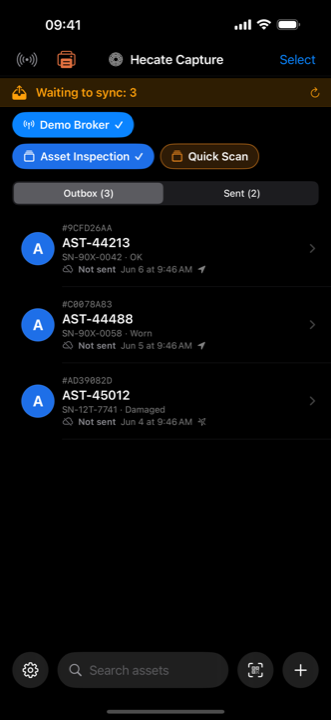
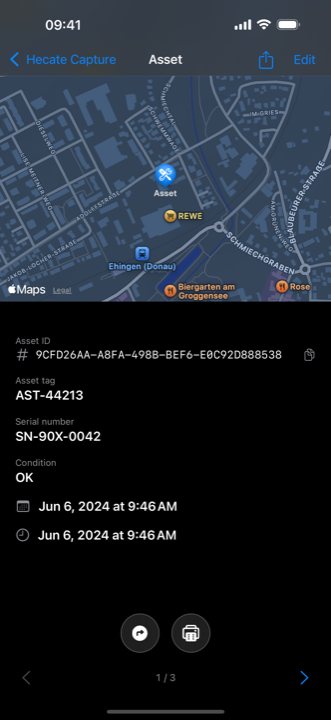
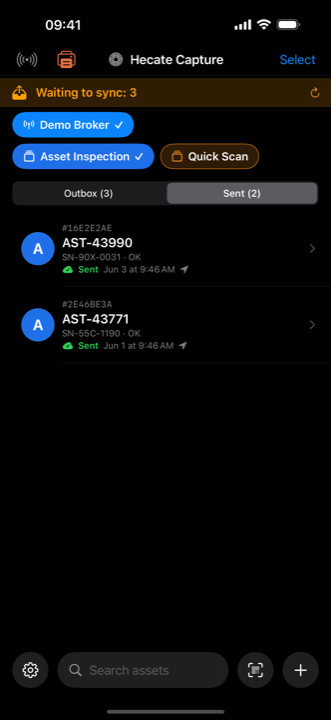
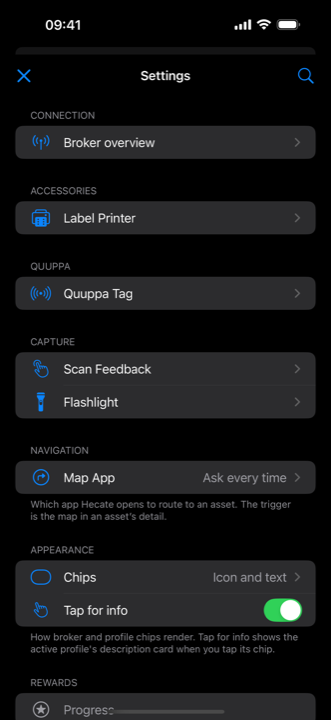
Screens come from development builds. Some may show features that require a subscription or arrive in a later release — what the free tier includes today is listed under Free & Pro.
The problem
Enterprises run a sprawl of single-purpose apps to record data along their process steps — one tool per use case, each built in isolation. Three failures follow.
Inconsistent quality
Every app validates (or fails to validate) its inputs differently, so the data that reaches downstream systems is uneven and hard to trust.
Not enabled for mobile
Much of this capture still happens at a desk — not where the work actually is.
No location context
Almost none of it is geo-referenced, so a record rarely says where the thing it describes actually is.
In short
| Enterprise pain | |
|---|---|
| Many single-purpose capture apps | one new build per use case |
| Inconsistent data quality | every app validates differently |
| Not enabled for mobile | capture happens at a desk |
| No location context | records don't say where |
| Heavy infrastructure / IT lift | a backend and device management per tool |
| Ungoverned access | no consistent rule for who may capture what |
How Hecate removes each of these
What Hecate Capture does
Hecate collapses that sprawl into one configurable app — and fixes the data where it's created, not after the fact.
One app, defined by profiles
The input dialog for each use case is not coded — it is a profile: a small document that declares the steps, the fields, and the allowed input methods, distributed to devices over an MQTT topic. Change the profile and the same app serves a new use case, with no new build.
Validated at the source
Every field is checked against its declared format at the moment of capture, so bad data is stopped where it's created rather than cleaned up downstream.
The right input for each step
A profile's steps decide what is captured; each step picks the input method that fits the job:
- Manual entry. Type the value straight into the field.
- Camera scan. Point the device camera and let the on-device scanning frameworks read QR codes, 2D Data Matrix codes and 1D barcodes — no network round-trip and no third-party service.
Whichever method a step uses, the value flows through the same validation and capture pipeline, so a profile behaves identically no matter how the data arrives.
The building blocks
| Block | Input | Resulting field |
|---|---|---|
| Scan a QR code | QR code via camera | Text, optionally pattern-checked |
| Scan a barcode | 1D barcode (EAN, Code 128, …) | Text, optionally pattern-checked |
| Scan a 2D matrix code | Data Matrix via camera | Text, optionally pattern-checked |
| Capture a quantity | Number entry | Number |
| Tick a status checklist | Checkboxes — several may apply | Multi-select |
| Pick a reason | Radio buttons — exactly one applies | Choice (exactly one) |
| Enter text | Free text, one line | Text |
| Leave a comment | Free text, multi-line | Text, multi-line |
Always geo-referenced
Every record carries a GPS fix and is streamed in a uniform, self-describing envelope to the broker.
Governance with almost no infrastructure
The only things required are an MQTT broker and the app — no backend to operate, no device-management enrolment. Authority lives in the broker's permissions: an admin publishes retained profiles; a user sees only the profiles their credential is allowed to read, and captures against them.
Because everyone working a use case fills in the same validated profile, the data arrives consistent, comparable, and ready to use — by construction, not by after-the-fact cleanup.
How it removes each pain point
| Enterprise pain | How Hecate removes it |
|---|---|
| Many single-purpose capture apps | One app; each use case is a profile, not a new build |
| Inconsistent data quality | Per-field format validation, blocked at capture |
| Not enabled for mobile | A field-first iOS app, used where the work happens |
| No location context | Every record carries a GPS fix |
| Heavy infrastructure / IT lift | Broker + app only; profiles delivered as retained MQTT messages |
| Ungoverned access | Broker permissions decide who may read which profiles |
The name & the mark
Hecate is the Greek goddess of crossroads, thresholds and keys — she who stands at the boundary and holds what unlocks it. A field tool lives at exactly that edge: between the physical object in front of you and the digital systems that must learn about it. Hecate locates it, guides the capture, carries it onward to the broker, and holds the keys that unlock the path.
The mark is the Strophalos ("Hecate's Wheel") — a labyrinth of winding paths around a single hub: the routes through the field, and the messages converging on the broker at the centre.